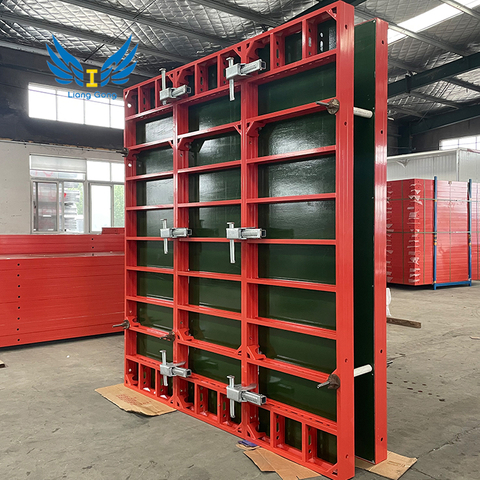
Lightweight Aluminum Frame Formwork can reduce on-site handling demands when the panel arrangement, access routes, crew sequence, and storage plan are designed around the actual work. “Lightweight” does not mean risk-free or effortless. Panels still need controlled lifting, correct connections, inspection, and orderly stacking. The practical advantage is that a lighter modular system may reduce dependence on heavy equipment for certain moves and make frequent repositioning more manageable, particularly on repetitive wall and column work.
Key Takeaways
Reduced handling comes from the complete workflow, not panel weight alone.
Panel dimensions, corner details, and access routes determine whether a lighter system saves time.
Reuse requires cleaning, inspection, repair, and disciplined stacking.
Compare aluminum with steel or timber by project geometry and cycle requirements, not by a single material claim.
Where the handling benefit begins
The Aluminum Frame Formwork category presents a reusable adjustable wall-and-column formwork product family. On suitable projects, modular aluminum panels can support a work plan in which units are carried or repositioned with less reliance on large lifting equipment than heavier alternatives. The actual allowable handling method must follow the component information, site risk assessment, and local safety controls.
Handling reduction starts at layout design. Avoid an arrangement that creates many narrow fillers, difficult corners, or repeated changes to tie positions. A well-planned module grid gives the crew a predictable sequence: receive, inspect, assemble, brace, pour, strip at the approved time, clean, and stack for the next work front.
Workflow area
How a lightweight system may help
Control still required
Delivery and storage
Smaller units can be organized nearer to the work face
Stable stacking, identification, and access control
Erection
Frequent repositioning may be easier
Approved braces, ties, alignment, and checks
Stripping
Panels may be moved in a more manageable sequence
Concrete release criteria and safe manual-handling limits
Reuse
Clean panels can return to the next cycle promptly
Inspection for damage, face condition, and missing hardware
Compare geometry before choosing the material
Lightweight Aluminum Frame Formwork is often best evaluated for repetitive walls and columns where the panel sizes match the structure. For slab work, a separate Aluminum Slab Formwork category should be assessed against slab geometry, support design, and stripping plan. A wall-formwork decision should not be extended automatically to slab construction.
For heavier concrete-pressure demands, large wall faces, or site conditions that favor a more robust panel family, compare the relevant Steel Frame Formwork system as a separate option. Material choice affects handling, but it also affects stiffness, connection style, lifting strategy, and how the system performs within the approved arrangement.
Make the work face easier to operate
Before delivery, map the route from unloading area to installation zone. Note lift entrances, stair or deck access, edge protection, storage limits, and interfaces with reinforcement and concrete-placement equipment. Then define the crew roles for panel preparation, erection, alignment, inspection, stripping, and cleaning. This reduces avoidable carrying and prevents the work face from becoming a mixed pile of panels, ties, and accessories.
Use a simple cycle checklist: inspect panel face; confirm hardware; position panels in installation order; assemble and brace to the approved layout; complete pre-pour inspection; strip only under the approved conditions; clean immediately; sort damaged or missing items; stack safely for the next pour. The efficiency gain is usually lost when this cycle is interrupted by poor storage or unplanned searching for parts.
Where multiple floors are active, coordinate aluminum panel movement with the high-rise building formwork solution. Crane time, hoists, access routes, reinforcement, and vertical forms should be planned as one logistics system.
Conclusion
Lightweight Aluminum Frame Formwork can reduce handling effort by making a modular, repeatable workflow easier to organize. It does not remove the need for safe lifting, bracing, inspection, or an approved stripping sequence. Lianggong Formwork offers aluminum frame formwork alongside steel and slab system categories, allowing the project team to compare material and layout choices against real geometry and site constraints. The right system is the one that creates a cleaner, safer, repeatable work cycle.
FAQs
What makes Lightweight Aluminum Frame Formwork easier to handle?
Its potential advantage is a lighter modular panel workflow, but the actual benefit depends on panel size, access, crew method, and site controls.
Can aluminum frame panels be used for slabs?
Slab work should be assessed with the appropriate slab-formwork system and its support, geometry, and stripping requirements.
Is aluminum formwork always better than steel?
No. The correct choice depends on concrete element, pressure, repetition, lifting plan, surface requirement, and lifecycle use.
How can a site preserve the handling benefit?
Use a planned delivery route, staged storage, installation order, clear component identification, and immediate cleaning after stripping.
What should buyers request before purchase?
Request the panel layout, connection details, approved configuration information, component list, handling guidance, and the project-specific inspection process.

 한국어
한국어 Tiếng Việt
 Bahasa Melayu
 Filipino
 Bahasa Indonesia
 العربية
 Français
 Русский
 Español
 Português
 English
 Deutsch
 italiano
 日本語
日本語 Nederlands
 ไทย
ไทย Polski
 Türkçe
 አማርኛ
አማርኛ ພາສາລາວ
 ភាសាខ្មែរ
 ဗမာစာ
ဗမာစာ தமிழ்
தமிழ் magyar
 Română
 Čeština
 Монгол
 қазақ
қазақ Српски
 हिन्दी
 فارسی
فارسی Kiswahili
 Slovenčina
 Slovenščina
 Norsk
Norsk Svenska
 українська
 Ελληνικά
 Suomi
Suomi Հայերեն
 עברית
עברית Latine
 Dansk
Dansk اردو
اردو Shqip
Shqip বাংলা
বাংলা Hrvatski
 Afrikaans
 Gaeilge
 Eesti keel
 Māori
Māori नेपाली
 latviešu
 অসমীয়া
 Беларуская мова
 Български
 डोग्रिड ने दी
 Esperanto
 Eʋegbe
 íslenska
 Türkmençe