High concrete pours create one of the most stressful moments on a construction site. Tall walls, fast pouring schedules, and dense reinforcement all combine to generate extreme lateral forces that test every connection in the formwork system. A single weak joint can quickly turn into leakage, deformation, or even a blowout that stops work and creates safety risks. This is why many contractors and engineers ask the same question before committing to a wall system: can H20 Timber Beam Formwork really withstand high concrete pressure in demanding wall applications? This article looks closely at where concrete pressure comes from, how a timber beam wall system resists it, and what practical site controls help ensure safe, stable pours using Lianggong’s modular wall formwork solutions.
What “High Concrete Pressure” Actually Means on Site
Concrete pressure on wall formwork is often discussed as a single number, but on site it behaves in more complex ways. Understanding this behavior is the first step in deciding whether a wall formwork system is suitable for high-pressure conditions.
Hydrostatic vs. Rate-Controlled Pressure
Fresh concrete initially behaves much like a liquid. When poured into tall wall formwork, it can exert nearly hydrostatic pressure, especially if the concrete remains workable for a long time. As hydration progresses and the concrete begins to set, the pressure gradually reduces and becomes rate-controlled. In real projects, walls often experience a combination of these two behaviors. High concrete pressure usually occurs when the concrete stays fluid longer than expected or when the pouring rate is too fast for the setting process to reduce lateral loads.
The Five Variables That Change Pressure Fast
Several site variables can quickly push wall pressure into a high-risk range. Pour rate is often the most influential factor, as faster lifts increase the height of fresh concrete before lower layers gain strength. Concrete temperature also plays a key role, since cold mixes set more slowly and maintain higher pressure for longer periods. Slump and overall workability influence how fluid the concrete behaves against the formwork surface. Vibration intensity can locally increase pressure if overused or applied for too long. Finally, wall height directly affects cumulative pressure, with taller walls placing greater demands on the formwork system. High concrete pressure is rarely caused by one factor alone; it is the combined effect of these variables acting together.
Where Wall Formwork Usually Fails Under Pressure
Failures during high-pressure wall pours are rarely random. They tend to occur at predictable weak points where the system cannot adequately transfer or resist lateral loads.
Joint Opening and Loss of Tightness
The most common failure mode is joint opening. When connections between panels or walers lose tightness, even slightly, concrete paste can escape. Once leakage starts, pressure concentrates on nearby connections, increasing the risk of progressive failure. Maintaining consistent tightness across all joints is critical in high-pressure situations.
Waler Misalignment and Weak Junctions
Walers form the main horizontal load path in a wall formwork system. If walers are misaligned or poorly connected, they cannot distribute pressure evenly. Weak junctions between walers can become stress concentration points where deformation begins. Over time, this deformation can amplify under sustained concrete pressure.
Insufficient Bracing During Pouring
Even a well-designed wall panel can fail if it is not adequately braced. During pouring, unbalanced loads and vibration can cause panels to move or rotate if bracing is insufficient. This movement not only affects dimensional accuracy but also increases pressure on certain connections, pushing them beyond their intended capacity.
How H20 Timber Beam Wall Formwork Carries Load
To understand why H20 Timber Beam Wall Systems are widely used in demanding projects, it is helpful to look at how loads are carried through the structure of the formwork.
Steel Walers as the Main Load Path
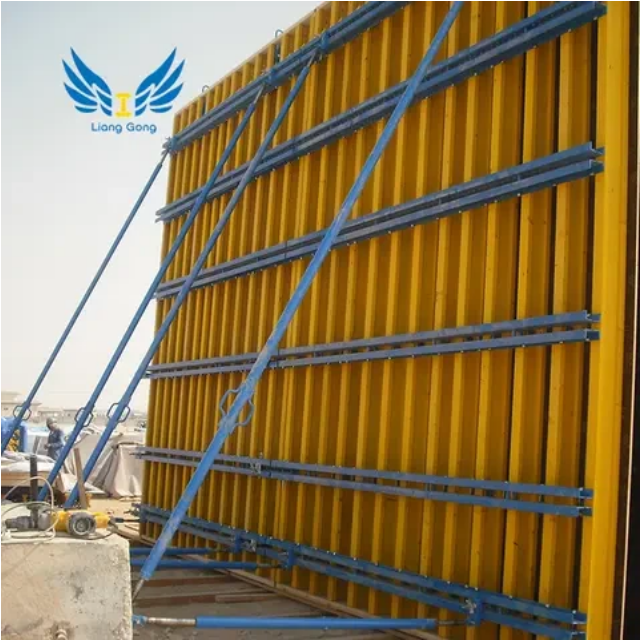
In H20 timber beam wall formwork system, steel walers act as the primary horizontal load-bearing elements. They receive lateral pressure from the formwork panels and distribute it across a larger area. By spanning between vertical supports and ties, walers help ensure that pressure is not concentrated at a single point. Lianggong manufactures steel walers to project-specific lengths, which allows them to fit precisely into the intended load path and improve overall stability.
H20 Timber Beams as Secondary Support
H20 timber beams provide the vertical and secondary structural support that connects the formwork facing to the walers. These beams are designed to offer a strong strength-to-weight ratio, making them suitable for tall wall applications without excessive self-weight. By working together with steel walers, H20 beams help maintain panel alignment and resist bending under pressure.
Why Adjustable Connections Matter Under Tension and Compression
Concrete pressure does not act in a single direction. During pouring and vibration, connections experience both tension and compression. Lianggong’s wall formwork system uses steel walers and connectors with longitudinally formed holes, allowing the tightness of connections to be adjusted as loads change. This adjustability helps maintain contact between components under varying conditions, reducing the risk of joint opening or slippage during high-pressure pours.
The Connection Details That Help Resist High Pressure
Connections are often the deciding factor in whether a wall formwork system performs well under pressure. Small design choices at connection points can have a large impact on site safety and concrete quality.
Waling Connectors and Wedge Pins in Daily Use
In Lianggong’s H20 timber beam wall formwork, each waling junction is secured using waling connectors and wedge pins. Typically, two connectors and multiple wedge pins are used at each junction to create a tight and reliable connection. The wedge pins allow crews to apply consistent clamping force quickly, ensuring that walers remain firmly in place throughout the pour. This simple but effective mechanism is especially valuable when working under time pressure on site.
Keeping Panels Flush to Reduce Leakage Paths
High concrete pressure tends to exploit even the smallest gaps. Maintaining flush alignment between panels is essential to prevent leakage and surface defects. Adjustable connections help crews fine-tune panel positions during assembly, reducing uneven joints that could otherwise become leakage paths once pouring begins.
Why Repeatable Connection Geometry Reduces Site Variability
One challenge on many projects is variability in workmanship. When connection geometry is repeatable and standardized, crews can assemble panels with greater consistency. This repeatability reduces the likelihood of uneven tightening or misalignment, both of which can increase risk under high concrete pressure. A modular system with predictable connections supports safer and more reliable wall pours.
Diagonal Brace and Alignment as Hidden Pressure Resistance
While walers and beams carry most of the structural load, diagonal brace and alignment play a crucial supporting role in resisting concrete pressure.
Push-Pull Props for Erection Stability
Push-pull props, also known as panel struts, are mounted on steel walers to assist in the erection and alignment of wall panels. Their length is selected based on the height of the formwork panels, allowing crews to adjust verticality accurately. During pouring, these props help resist horizontal movement caused by concrete pressure and vibration, keeping the wall stable until the concrete gains sufficient strength.
Platform Brackets and Safe Working Positions
High-pressure wall pours often require careful coordination between pouring, vibration, and inspection. Wall formwork systems can be connected to working and concreting platforms using top console brackets. These platforms provide safe access for workers to monitor joints, adjust vibration practices, and respond quickly if any signs of distress appear during the pour. Good access supports better control of high-pressure conditions.
Practical Jobsite Checklist Before a High-Pressure Pour
Even a robust wall formwork system benefits from disciplined site practices. Before pouring concrete under high-pressure conditions, crews should carry out a structured checklist to minimize risk.
Pre-Pour Inspection Points
Before pouring begins, all waler connections should be checked for proper tightness. Panels should be aligned and flush, with no visible gaps. Diagonal brace and push-pull props must be securely installed and adjusted to maintain verticality. Ties and anchors should be verified to ensure they match the expected pressure levels.
During-Pour Monitoring Signals
During the pour, crews should watch for early warning signs such as unexpected leakage, unusual movement, or excessive vibration effects. Monitoring pour rate and vibration practices in real time helps prevent pressure from building faster than the system can safely handle.
When to Slow the Pour or Add Bracing
If conditions change during pouring, such as a sudden drop in concrete temperature or increased workability, it may be necessary to slow the pour rate or add temporary bracing. Making these adjustments early can prevent small issues from escalating into serious failures.
High Concrete Pressure Risk Checklist for Wall Formwork
Pressure driver | What you observe on site | Risk to formwork | Mitigation action |
Pour rate | Faster lifts | Sudden pressure spikes | Slow pour or use staged lifts |
Temperature | Cold concrete | Longer high-pressure duration | Adjust pour plan and timing |
Slump/workability | Very fluid mix | More hydrostatic behavior | Tighter quality control |
Vibration | Over-vibration | Local pressure and leakage | Standardize vibration method |
Wall height | Tall lifts | Cumulative pressure | Add walers or props |
This checklist highlights how technical design and site management work together to control high concrete pressure effectively.
Conclusion
High concrete pressure is one of the most demanding challenges in wall construction, but it does not have to be a limiting factor. When load paths, connections, bracing, and pouring practices are treated as a single coordinated system, H20 timber beam wall formwork can perform reliably even under demanding conditions. Lianggong’s modular wall solutions combine steel walers, H20 timber beams, adjustable connection details, and practical bracing components to support safe, stable pours across a wide range of wall heights and concrete behaviors. If you are planning a project where wall pressure is a critical concern, the H20 timber beam wall system from Lianggong offers a proven and adaptable solution. To discuss your specific wall layout and pouring conditions, contact us today and let our technical team help configure the right formwork system for your project.
FAQ
Can H20 timber beam wall formwork be used for very tall walls?
Yes. With properly designed walers, connections, and bracing, H20 timber beam wall formwork is commonly used for tall wall applications where concrete pressure is high.
How do adjustable connections help with concrete pressure?
Adjustable connections allow crews to maintain tight joints under changing tension and compression during pouring, reducing the risk of leakage and joint opening.
Does pour rate really affect wall formwork pressure?
Pour rate has a major impact. Faster pours increase the height of fresh concrete and can significantly raise lateral pressure before lower layers begin to set.
What site practices are most important for high-pressure pours?
Consistent connection checks, controlled pour rates, proper vibration, and adequate bracing are all essential for managing high concrete pressure safely.

 한국어
한국어 Tiếng Việt
 Bahasa Melayu
 Filipino
 Bahasa Indonesia
 العربية
 Français
 Русский
 Español
 Português
 English
 Deutsch
 italiano
 日本語
日本語 Nederlands
 ไทย
ไทย Polski
 Türkçe
 አማርኛ
አማርኛ ພາສາລາວ
 ភាសាខ្មែរ
 ဗမာစာ
ဗမာစာ தமிழ்
தமிழ் magyar
 Română
 Čeština
 Монгол
 қазақ
қазақ Српски
 हिन्दी
 فارسی
فارسی Kiswahili
 Slovenčina
 Slovenščina
 Norsk
Norsk Svenska
 українська
 Ελληνικά
 Suomi
Suomi Հայերեն
 עברית
עברית Latine
 Dansk
Dansk اردو
اردو Shqip
Shqip বাংলা
বাংলা Hrvatski
 Afrikaans
 Gaeilge
 Eesti keel
 Māori
Māori नेपाली
 latviešu
 অসমীয়া
 Беларуская мова
 Български
 डोग्रिड ने दी
 Esperanto
 Eʋegbe
 íslenska
 Türkmençe