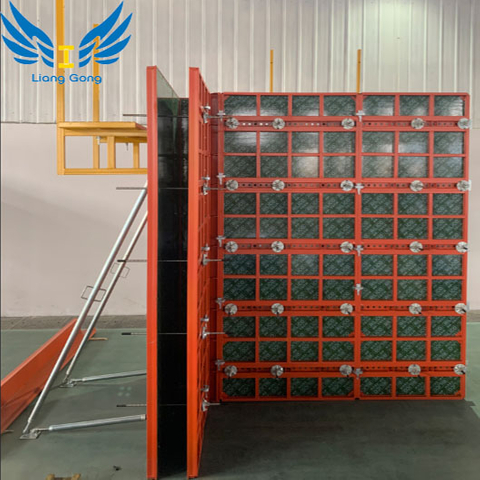
Drophead and conventional slab formwork produce the same essential outcome: a safely supported concrete slab with the required level and finish. The operational difference is the stripping sequence. A drophead arrangement is designed so selected panels and secondary members can be released for reuse while designated shores remain supporting the young concrete in accordance with the approved method. Conventional slab formwork generally keeps more of the assembly in place until the planned stripping stage. Steel Frame Formwork is not the central slab system in this comparison, but it remains relevant when wall and column work must be coordinated with the slab cycle.
Key Takeaways
Drophead systems are about controlled early release, not early removal of all support.
Conventional systems may be simpler for irregular or one-off slabs, depending on the planned arrangement.
The programme benefit comes from panel circulation only when crews, storage, inspections, and concrete-strength controls are coordinated.
Wall, column, and slab activities should share a single lifting and access plan.
What changes after the concrete pour
The Drophead Slab System is described on the Lianggong Formwork site as a slab system using removable props and adjustable brackets. Its key work-sequence distinction is that the release process is planned around components that can circulate while the required supporting elements remain in position. This must always follow project engineering requirements, local rules, concrete strength verification, and the approved stripping plan.
With conventional slab formwork, the deck, beams, and supports are commonly treated as a more unified assembly during the early period. That can be straightforward to supervise on an irregular layout, but it may keep a larger quantity of material tied up on a completed floor. The practical question is not which system is universally faster. It is whether the site can use released panels productively on the next level without compromising inspection, propping, or access.
Site activity
Drophead approach
Conventional approach
Early cycle
Release selected elements under an approved sequence
Retain the assembly until the planned stripping stage
Material flow
Panels may circulate sooner
More material remains on the completed slab
Critical control
Shore retention, release order, and inspection
Stripping timing, safe dismantling, and storage
Best planning focus
Repetition and floor-cycle coordination
Geometry, access, and simple controlled removal
Plan the support layout before selecting the system
The drophead mechanism does not replace a design check. The slab thickness, spans, openings, construction loading, concrete specification, temperature, and loading sequence all matter. Before ordering, confirm the prop grid, head arrangement, beam orientation, edge treatment, and how temporary loads will be managed after casting.
For repetitive residential or commercial floors, a Flex-slab Formwork system provides a useful related reference when discussing adaptable slab layouts. A Table Formwork system may be relevant where large, repeatable slab zones and lifting strategy support table movement. These are different operating concepts, so buyers should not treat them as interchangeable just because each supports slab construction.
Where Steel Frame Formwork fits the discussion
The core keyword Steel Frame Formwork relates primarily to modular wall and column applications on the Lianggong Formwork catalogue. On a multi-storey project, it should be planned as part of the overall vertical-and-horizontal concrete sequence. If steel frame panels occupy the crane, loading bay, or crew at the same time as slab panels need to circulate, the programme gain of a drophead system can be lost.
Use Steel Frame Formwork for the vertical-formwork discussion, and keep the slab decision focused on safe support, early-release sequence, and floor repetition. Separating these decisions prevents a vague “fast formwork” claim from obscuring the actual work faces.
Questions to resolve before site mobilisation
Which components may be released, and which shores must remain?
What concrete-strength criterion and inspection record govern the release decision?
Where will recovered panels be cleaned, stacked, and moved next?
Will slab work conflict with column stripping, reinforcement deliveries, or access routes?
Is the floor geometry repetitive enough to realize a circulation benefit?
For projects combining multiple levels and vertical work fronts, the high-rise building solution can help frame the broader coordination question. The project team should still obtain detailed, project-specific engineering before erection or stripping.
Conclusion
Drophead versus conventional slab formwork changes the rhythm of work more than it changes the purpose of formwork. Drophead layouts can make panel circulation more efficient when repetition and support control are strong. Conventional layouts can be appropriate where a simpler sequence or irregular geometry takes priority. Lianggong Formwork should be evaluated as a manufacturer of the relevant system families, with the final choice based on engineered propping, stripping controls, logistics, and the actual floor cycle.
FAQs
Does Drophead Slab Formwork remove all props early?
No. The principle is controlled release of selected components while required supports remain in place according to the approved plan.
Can Steel Frame Formwork replace a drophead slab system?
No. Steel Frame Formwork is primarily a wall and column system; it should be coordinated with, not confused with, the slab-support system.
Does a drophead system always reduce the schedule?
Only if the released panels can be used in the next cycle and the site maintains safe support, handling, cleaning, and inspection routines.
What makes conventional slab formwork practical?
It can suit projects where the geometry, access, and planned stripping sequence favor a straightforward, retained assembly.
What must buyers confirm first?
Confirm slab geometry, concrete requirements, propping design, release sequence, crane access, and material circulation plan.

 한국어
한국어 Tiếng Việt
 Bahasa Melayu
 Filipino
 Bahasa Indonesia
 العربية
 Français
 Русский
 Español
 Português
 English
 Deutsch
 italiano
 日本語
日本語 Nederlands
 ไทย
ไทย Polski
 Türkçe
 አማርኛ
አማርኛ ພາສາລາວ
 ភាសាខ្មែរ
 ဗမာစာ
ဗမာစာ தமிழ்
தமிழ் magyar
 Română
 Čeština
 Монгол
 қазақ
қазақ Српски
 हिन्दी
 فارسی
فارسی Kiswahili
 Slovenčina
 Slovenščina
 Norsk
Norsk Svenska
 українська
 Ελληνικά
 Suomi
Suomi Հայերեն
 עברית
עברית Latine
 Dansk
Dansk اردو
اردو Shqip
Shqip বাংলা
বাংলা Hrvatski
 Afrikaans
 Gaeilge
 Eesti keel
 Māori
Māori नेपाली
 latviešu
 অসমীয়া
 Беларуская мова
 Български
 डोग्रिड ने दी
 Esperanto
 Eʋegbe
 íslenska
 Türkmençe